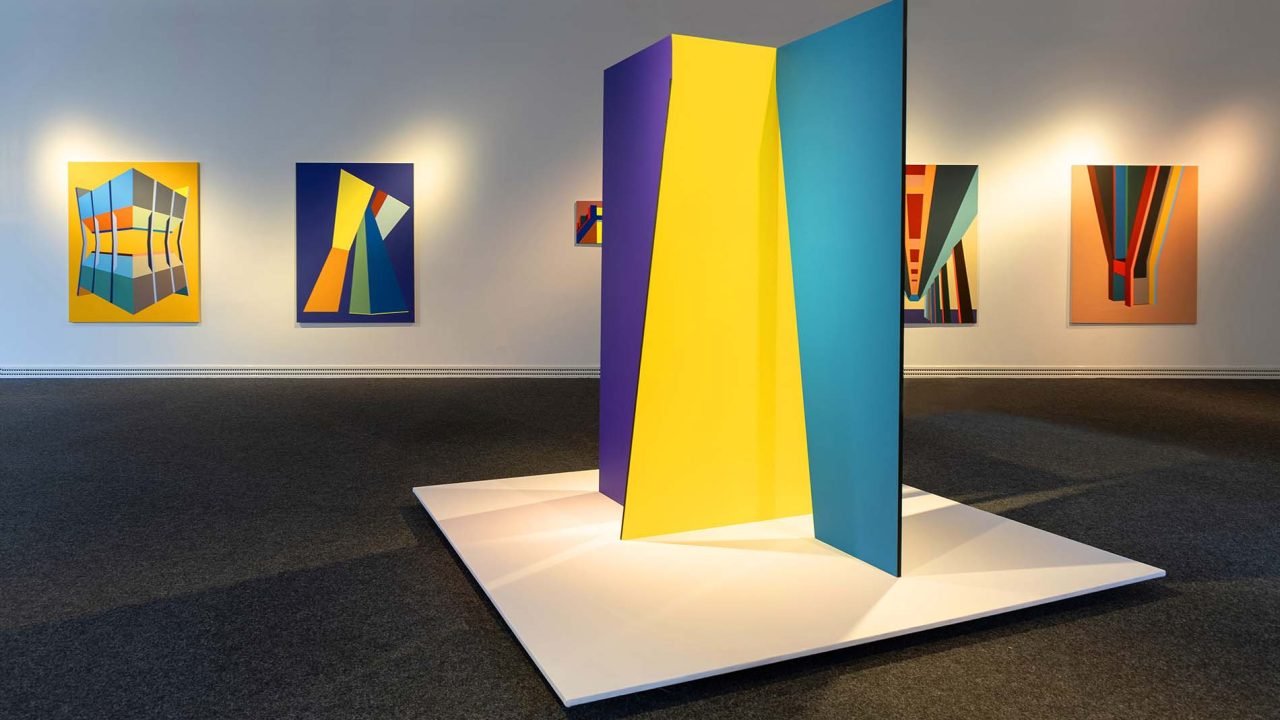
„Raumkreuzer“ hat die Künstlerin Sandra Tröger ihren Bildzyklus betitelt, den sie in der Stadtgalerie Amberg erstmalig präsentiert. Die großformatigen Kompositionen zeichnen sich durch exakt begrenzte, leuchtende Farbflächen aus, die zwischen angedeuteter Dreidimensionalität und Fläche oszillieren. Dabei generieren die Farben ihre eigene Räumlichkeit, überstrahlen die Flächen des Bildes und teilen sich dem umgebenden, realen Raum mit. Teils mit fluoreszierenden Pigmenten gemalt, entfalten die schwebenden Figurationen unter UV-Licht eine wirkmächtige Nachtseite.Sandra Trögers „Raumkreuzer“ verdanken sich Eindrücken, die die Künstlerin bei ihren Architekturstreifzügen mit der Kamera sammelt. Meist sind es Details, die schon im Moment des Fotografierens völlig abstrakt erscheinen: unabhängig vom Ort, der Zeit und dem Urheber. Die Fotos zeigen nicht mehr Architektur, sondern ein Bild, das vorgibt einen Raum zu zeigen. Nach der endgültigen Transformation des gefundenen Motivs zum Gemälde, wird es nur noch wenigen gelingen, Bauglieder der Amberger Glaskathedrale oder der Rosenthal Porzellanfabrik in Selb zu erkennen. Darum geht es auch nicht. Eher geht es um das Utopische im Raum des Bildes. Und manche Figuration wirkt dabei wie ein Raumschiff, das mit „Photonenantrieb“ aus einer Erzählung von Stanislav Lem herangeschwebt ist.
The artist Sandra Tröger has titled her series of paintings ‘Raumkreuzer’, which she is presenting for the first time at the Stadtgalerie Amberg. The large-format compositions are characterised by precisely defined, luminous areas of colour that oscillate between a suggested three-dimensionality and a two-dimensional plane. In doing so, the colours generate their own sense of space, outshining the surfaces of the picture and extending into the surrounding, real space. Partly painted with fluorescent pigments, the floating figurations reveal a powerful nocturnal aspect under UV light.Sandra Tröger’s “Raumkreuzer” (Space Cruisers) owe their existence to impressions the artist gathers during her architectural explorations with her camera. Mostly these are details that appear entirely abstract even at the moment of photographing: independent of place, time and the creator. The photos no longer depict architecture, but an image that purports to show a space. Once the found motif has been definitively transformed into a painting, only a few will be able to recognise architectural elements of the Amberg Glass Cathedral or the Rosenthal porcelain factory in Selb. But that is not the point. Rather, it is about the utopian quality within the space of the image. And some of the figurative elements appear like a spaceship that has floated in on ‘photon propulsion’ from a story by Stanislav Lem.Translated with DeepL.com (free version)